Glaze
Glaze and Decoration: How an Oil-Spot Grows
A glaze is a layer of glass fired onto clay. It governs touch, gloss and wear resistance, and it places a piece within an aesthetic lineage. This guide explains what glaze is made of, how Huairen's signature black-glaze oil-spot and kiln-transmutation effects actually form, and where the practical limits of daily care lie.
Updated 2026-08-13
What a glaze is
A glaze is a glass layer melted onto the body at high temperature and frozen there on cooling. It does three jobs: sealing open pores so the piece holds liquid, providing a smooth cleanable surface, and carrying colour and decoration. Its composition resembles glass — quartz forms the network, feldspar and oxides of calcium, magnesium and zinc act as fluxes to lower the melting point, and a little clay keeps it suspended and adherent. The first rule of glaze formulation is that the glaze must fit the body: if their thermal expansion coefficients differ, the glaze shrinks out of step on cooling and you get fine crazing or flaking.
| Family | Appearance | Process note |
|---|---|---|
| Gloss glaze | High gloss, sharp reflection | Standard, easy to clean, scratches show |
| Matte glaze | Soft, no hard highlight | Achieved by micro-crystals or opacity; hides fingerprints |
| Crystalline glaze | Visible crystals or speckles precipitate | Oil-spot and hare's-fur belong here; narrow firing window |
| Transmutation glaze | Flowing colour, every piece unique | Depends on atmosphere and kiln position; low repeatability |
| Colour glaze | Overall body colour such as celadon or grey | A Huairen differentiation line; colour consistency is the challenge |
How oil-spots form: bubbles carry iron to the surface
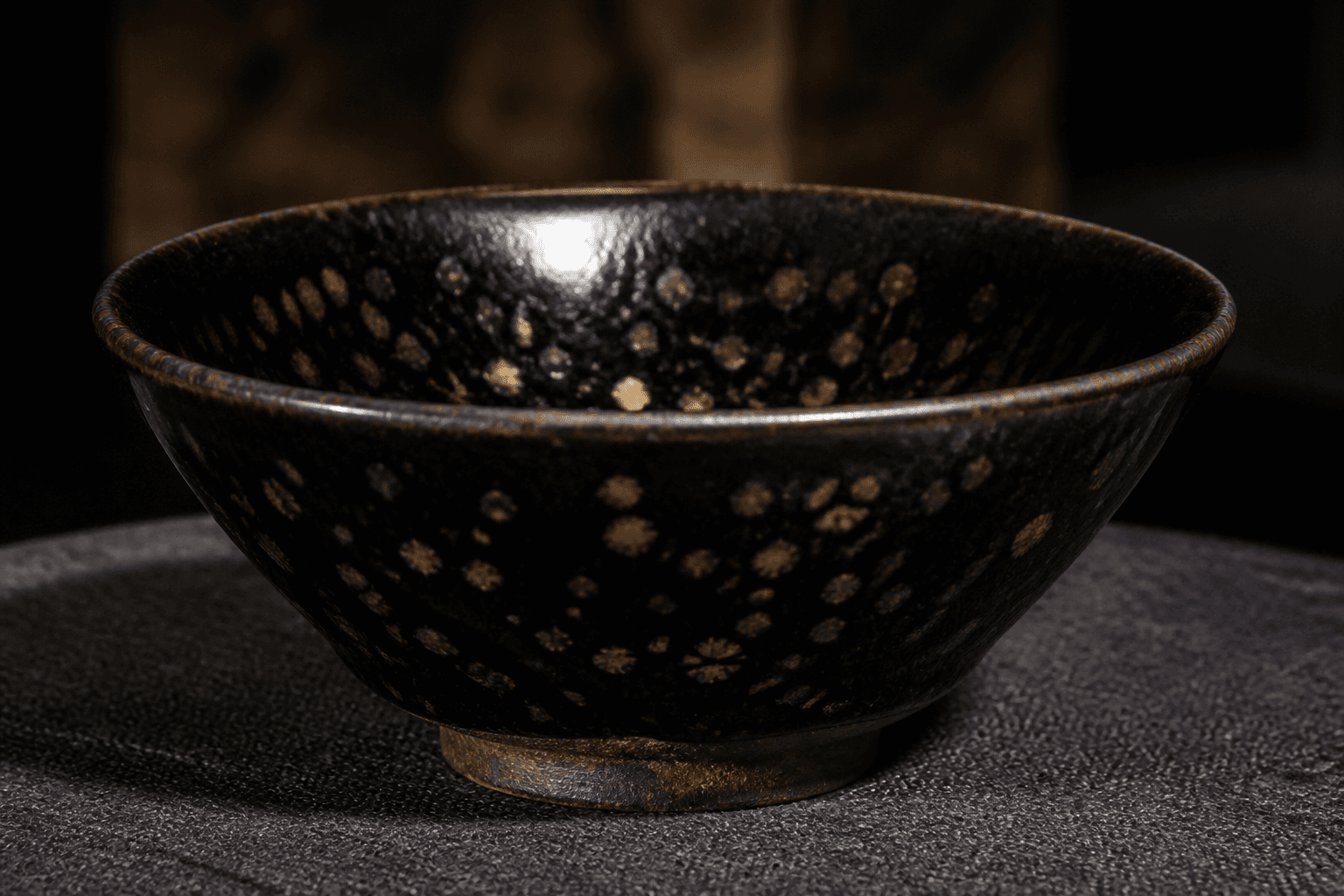
“Oil-spot” is a descriptive name; in modern classification it is a crystalline glaze whose speckles can read silver-white, grey or reddish. The accessible explanation is a bubble mechanism: once the kiln takes the glaze into melt, iron oxides in it decompose and release gas; bubbles rise, merge and burst within the viscous glaze, carrying iron-rich material to the surface. On cooling those iron-rich zones crystallise into individually bounded spots. The critical word is narrow — the firing window for oil-spot is very tight. Too cool and there is not enough bubbling for spots to develop; too hot and the glaze flows, smearing or erasing them. Historically this meant choosing kiln positions by experience and controlling the ramp curve tightly, so oil-spot came as a by-product of blackware production rather than a reliably mass-produced line.
Transmutation and gilding: two heritage-listed skills
Kiln transmutation refers to unplanned colour and flow effects produced by shifting temperature and atmosphere inside the kiln; no two pieces repeat and full reproduction is impossible. Huairen's black-glaze transmutation technique is listed as municipal intangible cultural heritage, one of three such entries. Another goes further: porcelain gilding is recognised by the Ministry of Culture and Tourism as national-level intangible cultural heritage. Gilding applies gold decoration over the glaze and fixes it at low temperature — visually high-specification, but it carries a use restriction, as metal-trimmed ware is generally not microwave safe. Together these show the district's capability range extends past high-volume white ware into value-added work that can carry giftware and cultural product lines.
Entrepreneur Daily: national gilding ICH and municipal transmutation ICH ↗
Decoration techniques
Beyond the glaze itself, how a pattern is applied shapes both cost and durability. Decal transfer dominates volume production: cheap, and patterns change quickly. Printing suits regular motifs at scale. Hand painting serves higher-value, smaller runs. Incising and sgraffito cut lines and motifs into the damp body — historically a strength of the Huairen kilns, whose bold carved and cut patterns carry distinct Yanbei character. Gold and silver banding is on-glaze work needing an extra low-temperature pass. When choosing a technique, weigh how the decoration's position relative to the glaze affects both abrasion resistance and food-contact safety.
Care: stating the limits plainly
The glaze surface sets the boundaries of daily use. Ware with metal trim — gilded, gold-lined or silver-banded — should stay out of the microwave. On-glaze patterns should not face prolonged scraping with hard objects or aggressive scouring powder, which matters especially for bone china since its decoration is usually on-glaze. Thermal shock is the main cause of breakage, so do not heat a piece straight from the fridge. GB/T 3298 measures thermal shock resistance and GB/T 34253 specifically covers fridge-to-microwave-to-oven suitability, so this data can be requested at purchase. Dishwasher suitability is measured as mechanical-wash resistance under GB/T 32680 — a verifiable figure rather than a verbal assurance.